A very happy 100th birthday to Route 66—all 2,448 miles of it!
What a long, strange trip the Mother Road has taken since its birth on paper on November 11, 1926, leading right up to its current centennial renaissance. Over the past century, millions of travellers have driven this legendary corridor: Dust Bowl refugees on the “road of flight,” military troops, classic car enthusiasts, families on cross-country road trips, roadside entrepreneurs, motorcyclists and countless international guests. Get your kicks—the open road is calling, and it offers something for everyone, especially night photographers.
Many of us on the National Parks at Night team have been exploring Route 66 for the last 30 years, and in 2024, we hosted our very first workshop along this iconic byway. We can happily report that the Mother Road is alive and well. Considerable funding has fueled a true centennial revival, bringing new historic markers, restored vintage gas stations and fresh roadside attractions. Even more inspiring is the next generation of “roadies” you will meet at almost every stop, working tirelessly to preserve and celebrate their local heritage.
Route 66 also shares deep ties with the National Park Service, which helps protect the corridor through its preservation programs and oversees more than 250 buildings, bridges and road alignments listed on the National Register of Historic Places. While Petrified Forest is the only official national park that Route 66 runs through, dozens of other national parks, monuments and historic sites sit along the corridor or within an easy detour.
To celebrate the centennial, we chose to share 12 of our favorite night photographs from Route 66. These images showcase the endless variety and after-dark inspiration waiting along the Mother Road after the sun goes down.
Chicago Sign. Chicago signifies the start (or reverse end) of Route 66. While the road isn’t as defined in Chicago, one of its most noteworthy locations is the Chicago Theater and its brilliant six-story electric sign. It is a designated Chicago Landmark and listed on the National Register of Historic Places, serving as an unofficial symbol of the city and a great place to kick off your night adventure along Route 66.
Nikon Z8 with a Nikon Z 24-70mm f/2.8 lens. 2.5 seconds, f/18, ISO 64. © 2024 Gabriel Biderman.
Neon Park. Re-creations and restorations of neon signs for long-defunct Route 66 businesses light up the night at the Route 66 Legends Neon Park in Springfield, Illinois, part of the Route 66 Experience at the Illinois State Fairgrounds.
Nikon D780 with a Nikon 24-120mm f/4 lens. 2 seconds, f/20, ISO 50. © 2024 Lance Keimig.
Historic Spencer Station. A preserved gas station and general store in Miller, Missouri, was one of our favorite stops on the first leg of our first Route 66 road-trip workshop in 2024.
Nikon D780 with an Irix 45mm f/1.4 lens. 8 seconds, f/8, ISO 100. © 2024 Lance Keimig.
The Gateway Arch. The lighting for the magnificent Gateway Arch in St. Louis was updated to LED fixtures in December 2023. The new system reduces energy consumption by 60 percent, and the bulbs last 30 times longer. They also make for some dramatic photo ops!
Nikon D780 with an Irix 45mm f/1.4G lens. 80 stacked frames shot at 20 seconds, f/2.8, ISO 100. © 2024 Lance Keimig.
The Blue Whale of Catoosa, Oklahoma. The Blue Whale of Catoosa is one of the most famous roadside attractions on the Mother Road. Ironically it has been there only since 1972, and it is difficult to shoot at night due to newly installed LED lights. However, it remains a place for people to gather and picnic, fish and enjoy the stars just outside Tulsa.
Nikon Z 8 with a Nikon Z 24-70mm f/2.8 lens at 38mm. 184 stacked images shot at 10 seconds, f/2.8, ISO 100. © 2026 Gabriel Biderman.
The Teetering Tower of Texas. More officially known as the Leaning Tower of Britten, this water tower has stood (barely) at a 10-degree angle since being installed in the 1980s. It was originally part of a truck stop—all but the tower burned to the ground in 1988.
Nikon D5 with a Laowa 20mm f/4 Shift lens. 45 stacked frames shot at 2 minutes, f/5.6, ISO 800. © 2026 Chris Nicholson.
Cadillac Ranch. One of the most popular art installations and photography stops on all of Route 66. Artists come and go, adding and taking: Bypassers stop during all hours of the day to (legally) add spray paint to the cars, and then photographers come to capture the ever-changing display. At night the painted cars are light painted by the glow of distant, passing headlights.
Nikon D5 with a Laowa 20mm f/4 Shift lens. Three stitched frames shot at 15 seconds, f/4, ISO 3200. © 2026 Chris Nicholson.
Blue Swallow Motel. One of the most iconic roadside motels on Route 66. Rooms are flanked by inset car garages, contain rotary-dial phones and have lawn chairs for lounging outside. Atop the office sits one of the most well-known neon signs along the route, advertising the much-sought-after “refrigerated air.”
DJI Mavic Air 2. 1/20, f/2.8, ISO 400. © 2026 Chris Nicholson.
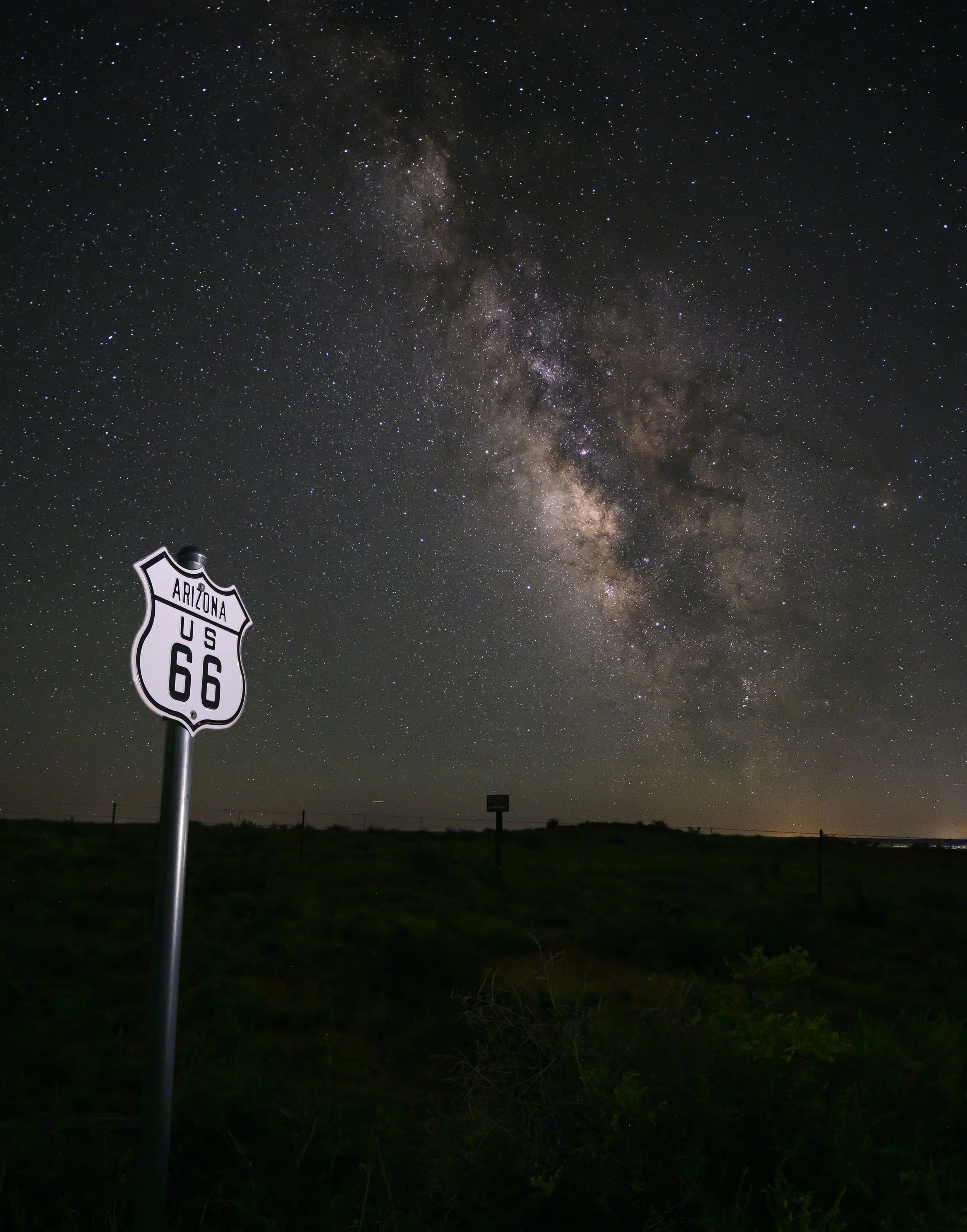
Route Milky Way, Arizona. New Mexico and Arizona offer some of the best dark skies along Route 66. This image was created right outside Petrified Forest National Park and is a focus stack of the light-painted Route 66 road sign blended with the Milky Way with minimal light pollution and no moonlight.
Nikon Z 8 with a Nikon Z 14-24mm f/2.8 lens at 17mm. 8 seconds, f/2.8, ISO 12,800. © 2026 Gabriel Biderman.
Petrified Forest National Park, Arizona. The only national park that Route 66 runs through is a dark sky gem. However, to prevent the theft of petrified wood, most of the park is closed to the general public at night. Gabe applied for a permit and was able to capture this 1-hour, and 17-minute star trail stack over the Painted Desert Inn.
Nikon Z f and Nikon Z 14-24mm f/2.8 lens. 77 stacked images shot at 60 seconds, f/2.8, ISO 1600. © 2026 Gabriel Biderman.
Roy’s Cafe, California. Roy’s Cafe in Amboy, California, is one of the most classic road signs along Route 66. The neon looks fantastic during twilight, but can be tricky to balance in an exposure at night. Luckily, Gabe made new friends at Roy’s and they were able to turn off the neon for this well-balanced 14-minute star trail.
Nikon Z 8 with a Nikon Z 24-70mm f/2.8 lens at 52mm. 55 stacked images shot at 15 seconds, f/4, ISO 400. © 2026 Gabriel Biderman.
Santa Monica Pier, California. The Santa Monica Pier marks the official end of the line of Route 66. It’s a thing of beauty to see, and you can dip your toes in the Pacific Ocean after many miles of dry deserts and Los Angeles traffic. You will be greeted by hundreds of other tourists while you are there, but Gabe always finds solace in ripping long exposures of the solar-powered Ferris wheel as the waves crash against the pier.
Nikon Z 8 with a Nikon Z 24-70mm f/2.8 lens. 2 seconds, f/16, ISO 64. © 2026 Gabriel Biderman.
Your Turn
Let’s enjoy this journey together. Have you photographed Route 66 in the dark? If so, what was your favorite creation?
Share in the comments below, or on our Facebook page, or on Instagram (tag us @nationalparksatnight #nationalparksatnight #seizethenight). Be sure to tell a story too—the technical aspects, the challenge overcome, or a tale of the experience.