It’s been just over a week since we experienced Spain’s first eclipse in over 100 years with an amazing group of National Parks at Night photographers.
It had all the feelings: Anticipation. Stress. Excitement. Stress. Thrill. And the moment itself—the release of it all. Light like we’ve never seen, felt or experienced before. And all in a minute and 20 seconds!
Throughout the experience, we were in a frenzy of clicking, bracketing, oohing and ahhhing.
What was so special this time was that the eclipse was low in the sky, only 6 degrees above the horizon.
We were just outside the Bardenas Reales Nature Reserve, which, unfortunately just a couple of weeks prior, had decided to close to the public for the eclipse. The legitimate fear of wildfires and recklessness had “eclipsed” some of their enthusiasm for welcoming thousands of chasers. It was unfortunate, because we had dreams of our group making images such as this fantasy composite (we can dream) of the reserve’s iconic Castildetierra rock formation:
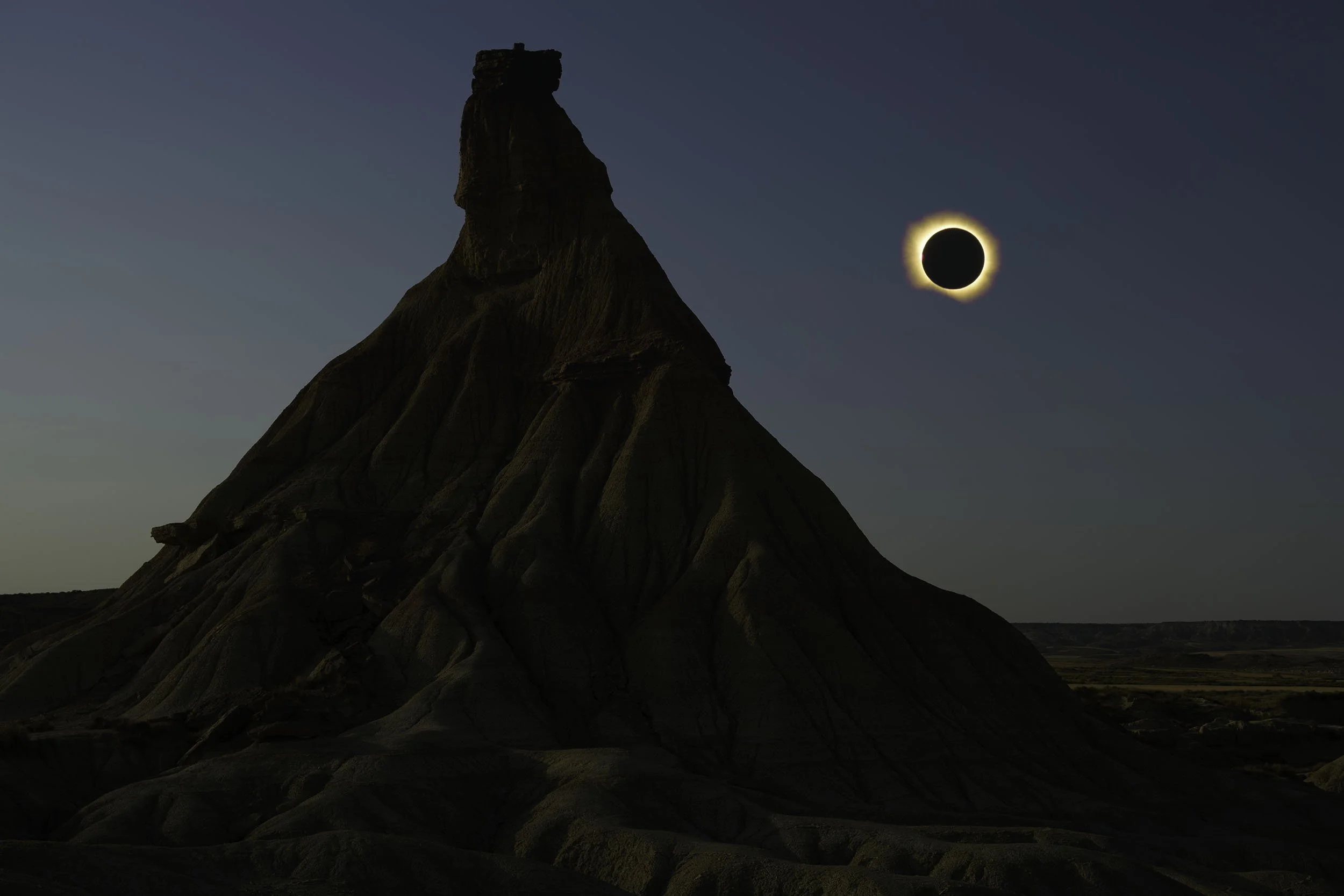
Castildetierra in Bardenas Reales Nature Reserve fantasy-composited with the total solar eclipse photographed the next day.
Moreover, concerned Spanish authorities were placing rigid restrictions on where people could view the eclipse in the area, limiting activity to designated roadside pullouts and the like.
Fortunately we had a Plan B. We had rented the unique Hotel Aire de Bardenas just outside of the park, where we could set up comfortably in relative privacy. The day was clear and hot, reaching 107 degrees F, so access to shade was a blessing.
The eclipse first contact started at 7:33 p.m. Totality started at 8:28. It lasted 1 minute, 20 seconds, and the sun set as a quarter eclipse along the horizon at 9:04.
I was leading this trip along with Chris Nicholson, and below we each discuss a photo we created.
Gabe’s Photo
This was my fourth eclipse, and it was by far the shortest. But it was also the most unique, because it was a sunset eclipse.
We didn’t have a great wide-angle foreground, so I focused on capturing the event with my Nikon 100-400mm telephoto lens zoomed all the way out at 400mm. With that focal length, I was able to hone in on the distant hills of the region.
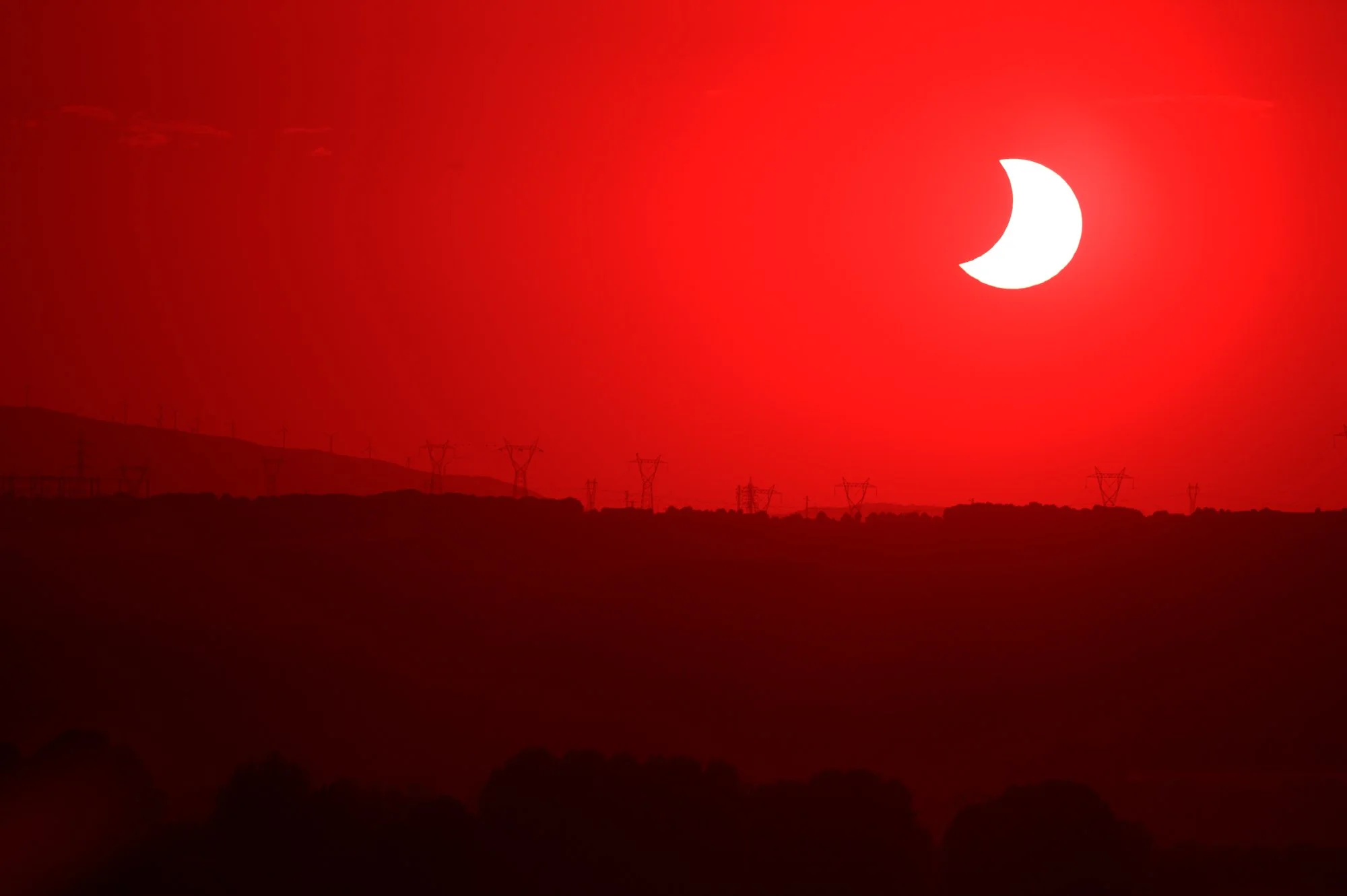
Capturing a close-up of the eclipse almost always means the rest of the scene is black, but including a sense of place was important to me. To accomplish that, I photographed the eclipse with my astro-modified Nikon Z 6II camera, and I continued to track the partial eclipse as it set along the horizon. I was mesmerized by the beautiful red-orange three-quarter crescent sunset (Figure 1), so I wanted to combine that with my earlier capture of totality (Figure 2).
Figure 1.
Figure 2.
To create the composite, I processed both images and then placed the total eclipse image over the sunset crescent.
The darkness of totality must be experienced by all, but the most defining part of totality close up is the glow of the sun behind the moon. I wanted to extend that luminous glow to the rest of the image to create this different take on the eclipse.
Eclipse setting over the hills of Spain. Astro-modified Nikon Z 6II with a Nikon 100-400mm f/4.5-5.6 lens. Two frames blended in Photoshop. Sun: 1/125, f/8, ISO 3200 with a Thousand Oaks Optical Solarlite solar filter; foreground: 1/1000, f/5.6, ISO 100.
Chris’ Photo
Like Gabe, I didn’t feel drawn to creating just a full-frame portrait of the eclipse, but rather wanted to make a photo that had a sense of place. To achieve that, I set up with a relatively short Nikon 24-70mm lens, zoomed out to 70mm. That allowed me to frame the landscape—a foreground farm field, backed by the hills and some windmills along the ridge—while still shooting with a focal length long enough so that the sun wouldn’t look tiny in the composition.
I set up my camera to shoot a five-frame bracket of shutter speeds, with each two stops apart (i.e., 1/2, 1/8, 1/30, 1/125 and 1/500) to make sure I got a good exposure at each phase of the eclipse, then I set my intervalometer to repeat that bracket every 2 minutes. When totality happened, I removed the solar filter and closed down the aperture from f/8 to f/16. After totality I replaced the filter and let the sequence keep running. The only adjustment I made was to increase the ISO (from 100 to 200 to 400) as the sun grew darker while approaching the horizon.
In Photoshop I composited 19 of the eclipse photos, masking out everything in each frame except the eclipsed sun, then changed the blending mode to Lighten. I layered the eclipse sequence over a foreground exposure that I’d made after sunset, then made a minor adjustment to lighten the landscape.
The one problem remaining was that the Lighten blending mode hid the darkened moon in the total eclipse. To fix this, I made a copy of the totality layer, changed its blending mode to Normal, then masked out everything except the dark moon. The result looked fake because the moon was too black against the rest of the scene, so I reduced the opacity to achieve a more realistic-looking result.
Eclipse phases over a Spanish landscape. Twenty frames blended in Photoshop. Nikon D5 with a Nikon 24-70mm f/2.8 lens. Sun phases: 1/125, f/8, ISO 100-400 with a MrStarGuy Natural Light solar filter; totality: 1/2, f/16, ISO 100; foreground: 1/30, f/8, ISO 200.
Final Thoughts
The primary takeaway from this experience was probably the importance of pivoting around obstacles. We had planned and confirmed our shoot location more than two years ahead and then lost access to it about two weeks ahead. We even got kicked out of the national reserve the evening before while practicing because authorities decided to spontaneously close the park early.
So, knowing how to alter your course is important. Having a Plan B is critical. And trusting that you know your process will always give you the peace of mind needed to succeed amid change.
When totality ended, the group cheered and enjoyed a glass of wine, toasting right there in the field behind our still-clicking cameras. When the eclipsing sun set below the horizon, we shared some tapas, then retired to the pool, where we watched Perseid meteors streak across a clear sky.
Your Experience
Did you get to see and/or photograph this eclipse? We would love to hear your tales and see your art.
Share in the comments below, or on our Facebook page, or on Instagram (tag us @nationalparksatnight #nationalparksatnight #seizethenight). Be sure to share your story too—the technical aspects, the challenge overcome, or a tale of the experience.