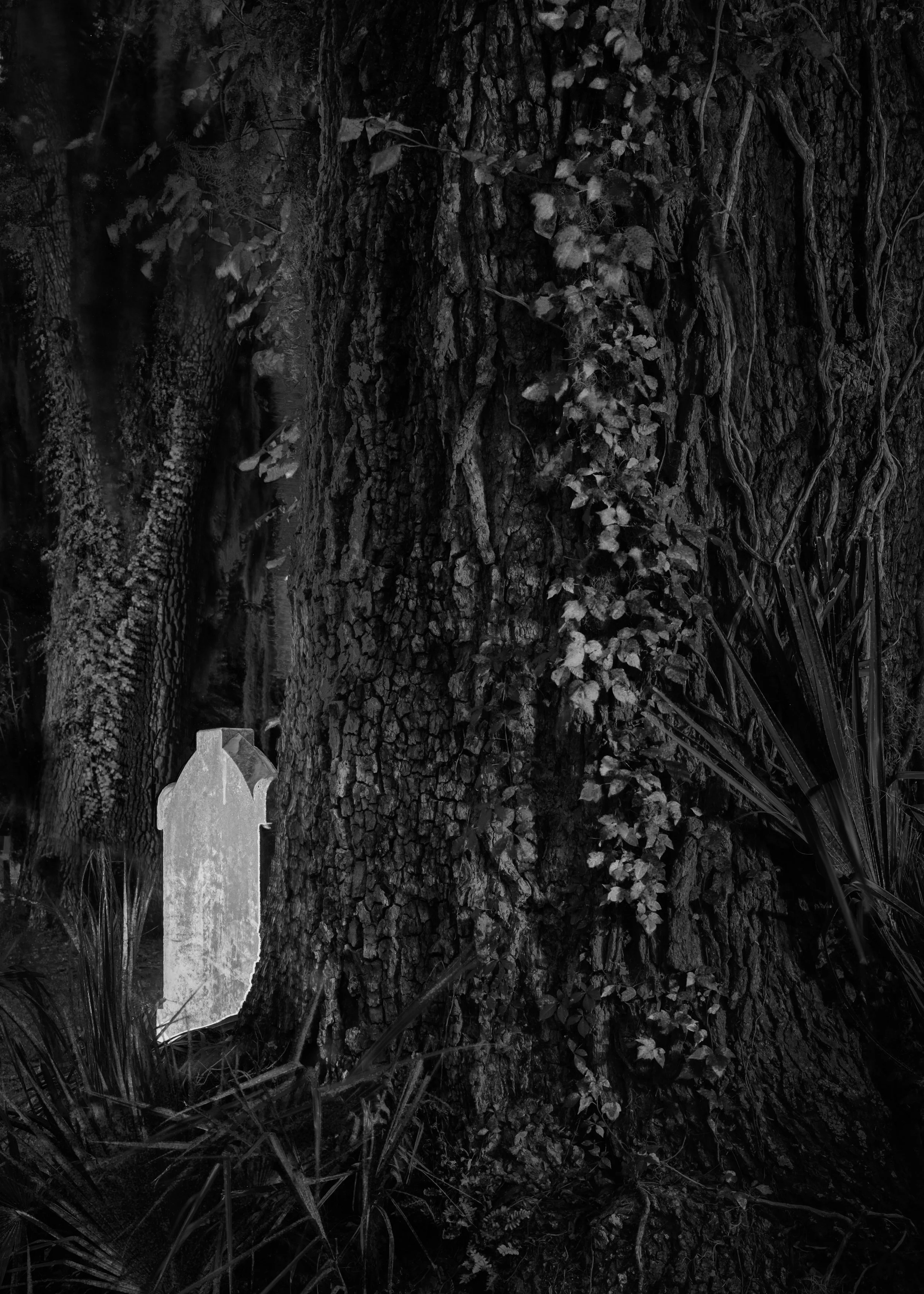
The end of another year is upon us! A time to celebrate with friends, family and loved ones. It’s also a time for reflection, appreciation and gratitude. Like so many others, we at National Parks at Night have an abundance to celebrate, appreciate and be thankful for.
First and foremost, we want to celebrate our alumni. We appreciate you. You’ve enabled us to spend the last ten years meeting new people, traveling to and photographing some of the most beautiful parts of the world. You’ve trusted us to help you on your journey to become better photographers. This has encouraged us to become better photographers too. Because of you, we’ve had the opportunity to make many new friends, and many new memories. We can’t possibly say thank you enough. Thank you!
This time of year is also a time for reflection. The cooler weather, shorter days and longer nights find us spending more time indoors, thinking over the past year and looking back at where we’ve been and what we’ve accomplished. We spend a little less time out in the field and a little more time with our Lightroom catalogs. Spending this time with our images allows us to magically re-experience all of those wonderful places we visited and to recall the magical time spent there.
This common experience has led to a tradition here at National Parks at Night: sharing our favorite images of the past year. Below you will find two images from each of us. These may not be our best photos (how can one judge the best?), but for myriad reasons they are our favorites.
Chris Nicholson
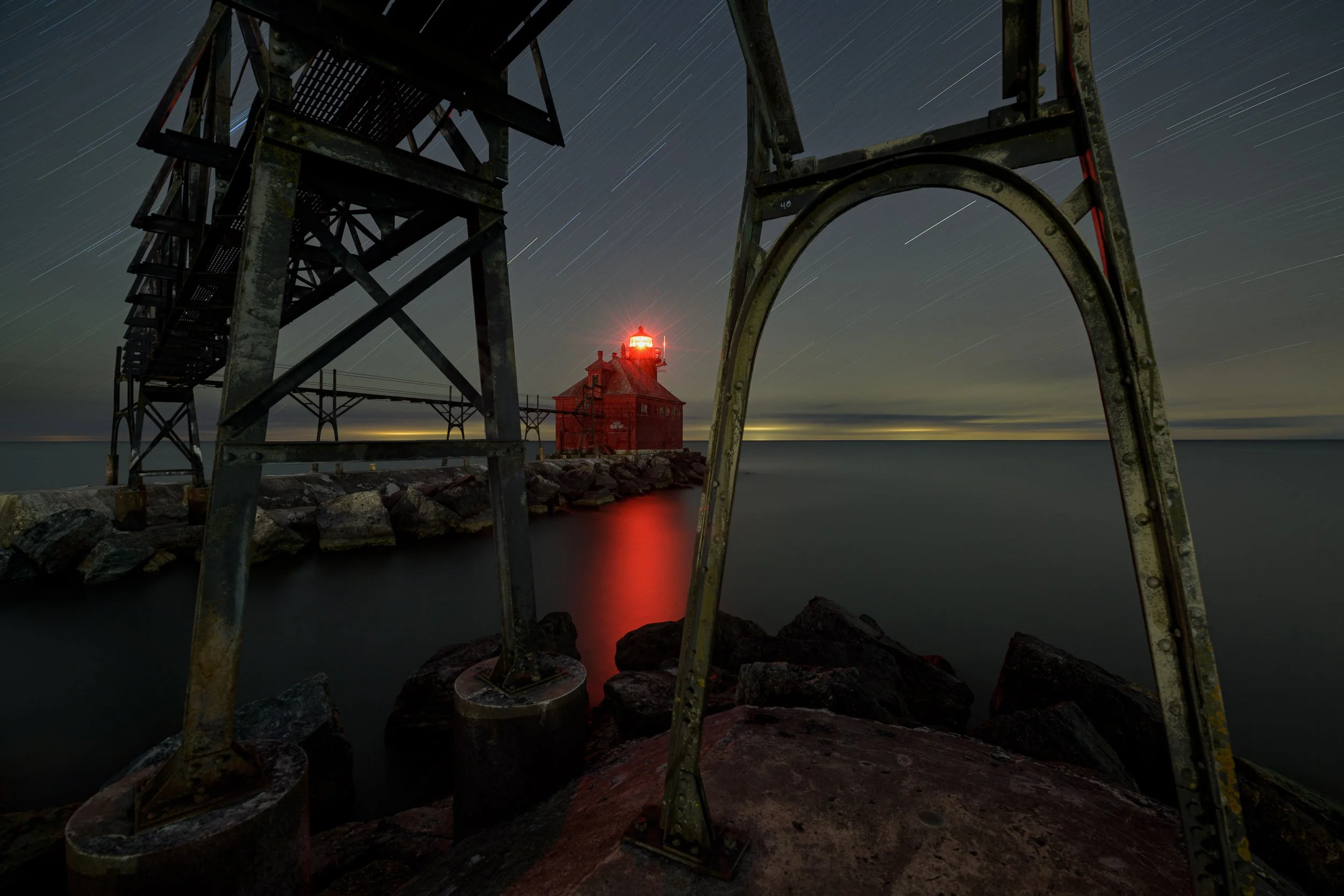
Sturgeon Bay Ship Canal Pierhead Front Lighthouse, Wisconsin
Nikon D5 with a Nikon 14-24mm f/2.8 lens. 27 minutes, f/5.6, ISO 800.
Frequently photographing lighthouses invites a problem not uncommon to any narrow niche: If you’re not careful, many of the photos tend to look the same. In this particular niche, it’s easy to end up with a portfolio full of what I call “lighthouse portraits”—just picture after picture of a tower dominating the composition, and the only thing different from one image to the next is the aesthetics of the structure.
One way to avoid that is relatively simple: Every time I photograph a new lighthouse, I identify whatever about the immediate environment is unique, and I then I try to structure a composition around that unique aspect. For the Sturgeon Bay Ship Canal Pierhead Front Lighthouse (a mouthful of a name, for sure!) in Wisconsin, that was easy: It has a rustic and rusty metal walkway that stands over the entire length of the quarter-mile pier that leads to the light. Moreover, another lighthouse (the rear beacon) on land flashes a red beam, washing the entire scene with a subtle warm cast.
I walked out to the end of the pier and saw that I could frame the lighthouse with the arch of the walkway, and I quickly knew that was something I wanted to build a composition around. I shot a few star-point exposures, and then decided to rip a longer shot. I suspected I was going to like the photograph, but when I saw the final version on the back of the camera, I knew I’d created something that I loved. I rarely get that excited about photo, but this one energized me for days.
Port Washington Breakwater Light, Wisconsin
Nikon D5 with a Laowa 20mm f/4 Zero-D Shift lens. 15 seconds, f/5.6, ISO 800.
About a month ago I was in Milwaukee with my daughter, Maggie, doing some random things, including stopping at the city’s three lighthouses—the first three she’d ever seen. She asked if there were more, so we drove half an hour to the Port Washington Breakwater Light and sat in the warm car peering at it standing over the waters of Lake Michigan. She looked at me and smiled, and asked if we could walk out to it. Half a mile. In 32 degrees F.
Yes, of course. We bundled ourselves in jackets and beanies and walked to the light, where we sheltered under the tower between its legs, and looked down at the frigid water, and talked with a friendly local fisherman. We took selfies, some with smiles, some with goofy expressions. Then we briskly walked back to land and got some hot chocolate.
Later I returned alone and created this photo of this unique lighthouse, along with the beacon across the channel, with nice rocks flanking the leading lines of the breakwater, with ice and snow creeping across the walkway. The exposure was pretty straightforward (moonlight, keep the stars sharp), as was the focus (infinity, with a 20mm lens)—the only thing “special” about executing the image was using a shift lens to prevent perspective distortion.
Still, this is perhaps my most cherished photo from 2025. It’s not about a lighthouse. It’s a “reminder” photo. It’s about how blessed I am to have a daughter who, at almost 13 years old, is still amused by curiosity, and who still wants to do things with me like walk half a mile to a lighthouse in a freezing breeze, and smile all the way there and all the way back. This photo will always be about Maggie.
Gabriel Biderman
Lake Myvatn Aurora Explosion, Iceland
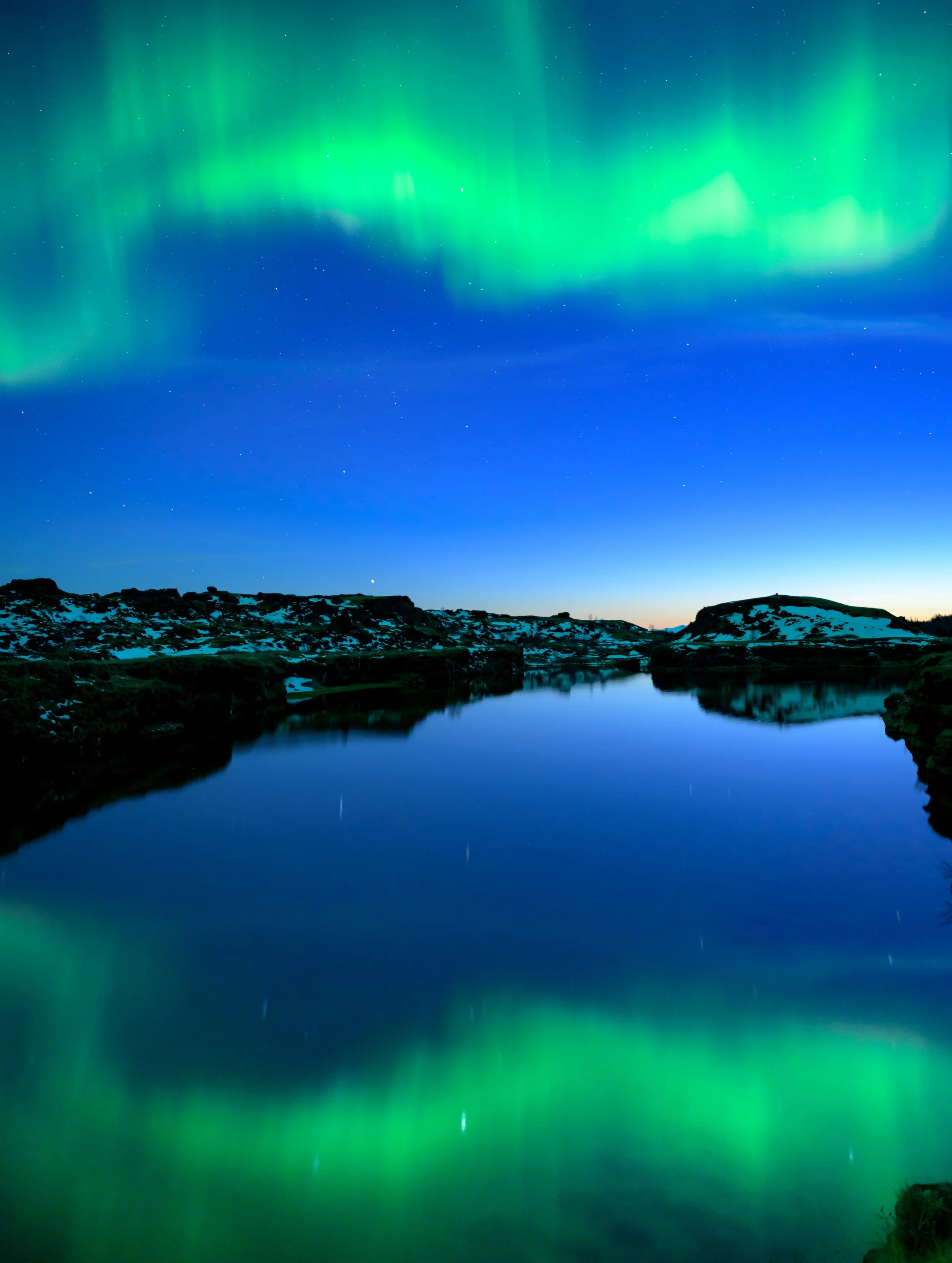
Nikon Z 8 with a Nikon Z 24-70 f/2.8 lens. 10 seconds, f/2.8, ISO 1600.
It was another amazing year of adventures under the stars, and my two favorite images bookended an absolutely stellar 2025!
My first trip of the year was with a small tight-knit group of explorers to Northern Iceland. April in the Arctic Circle can be challenging, as darkness lasts only 4 to 6 hours, the weather is frequently inclement, and solar activity anytime is sporadic enough to add to the struggle for good aurora viewing.
From the beginning of the trip we saw that our best time for clear skies would be the last night. We spent the week experiencing otherworldly vistas and tons of activities during the days, yet, true to the forecast, our nights remained socked in. We became more and more anxious for that last night’s weather prediction to prove true.
Our prayers to the geomagnetic gods were answered with an explosive light show unlike any we had ever witnessed prior. We chose to photograph around the volcanic landscape of Lake Myvatn, which offered wonderful compositions and reflections for the northern lights that were dancing in all directions. We shot for hours.
As morning twilight was beginning to break through the darkness, one last aurora eruption happened to the east. I quickly framed this image of blue and green light enveloping the approaching dawn. It lasted a few fleeting moments before it danced away.
It was one insanely epic night of auroras that made a grand finale to our trip and a night we’ll remember forever. With perma-grins on our faces, we left Iceland the next day completely satisfied.
Totem Pole during the Geminid Meteor Shower, Monument Valley
Nikon Z 8 with Nikon Z 14-24 f/2.8 lens. Foreground: 1 minute, f/2.8, ISO 1600. Sky/meteors: 43 stacked frames shot at 8 seconds, f/2.8, ISO 12,800.
We were chasing a different sort of celestial phenomenon on our last workshop of the year—the Geminids Meteor Shower in the wild landscapes of Monument Valley.
Our group spent hours of classroom time learning how to identify, capture and composite a single image filled with shooting stars. We scouted our spots and worked out the radiant alignment with the constellation Gemini and its two bright stars, Castor and Pollux. Our cold night started at 8 p.m. as we set up to collect on-camera as many meteors as we could until the moon rose at 3 a.m.
At our first location, instead of including Castor and Pollux in my frame, I decided to compose to the landscape. I knew I wanted a tighter shot of the iconic Totem Pole rock formation, and I also wanted additional foreground to lead the viewer into the scene. I focused on this Mojave yucca and lit it with a low-level light from overhead. I then focused on the stars and let the camera capture 687 shots with the radiant out of frame to the right.
The result was 43 frames containing long meteor streaks that I later blended together in Photoshop. Because the radiant was not in the frame, I didn’t have a visual reference to align the meteors, so I used a mixture of science and art to get everything in the right spots. The end result was all the meteors shooing past the Totem Pole in a dramatic way.
Just like with the aurora experience, tons of hoots and hollers greeted each magical moment that played out in our precious night skies.
Lance Keimig
Bisti Badlands Mushroom
Nikon D780 with a Tamron VR 15-30mm f/2.8G lens at 18mm. 20 seconds, f/4.5, ISO 6400.
Our Bisti Badlands trip in November resulted in my favorite domestic workshop of the past several years. Matt did such a great job planning and researching the area, and we had a wonderful Navajo guide with our great group. It was so much fun to explore these alien landscapes together, and to collaborate with about seven other people to light and photograph several mushroom-like structures in the desert.
For this photo, we spent about an hour refining the lighting, which involved four Luxli Fiddles and a Luxli Viola. As a bonus, we had some subtle auroras in the background (after experiencing a massive display the night before at Ship Rock).
This was one of those nights when everything clicked: a great location with a strong group of photographers, perfect weather, and a wonderful combination of clouds and light pollution augmented by a magenta aurora all adding interest to the sky and the overall composition. The mushrooms—or hoodoos, as they are properly called—were a source of endless fascination as well. Harder, more durable caps of sandstone rest on pillars or pedestals of shale and mudstone, which erodes more quickly and creates the iconic formations.
I made only three images that night, but each is a banger that I plan to hang on the wall in my home. I can’t wait to go back and further explore the area next May during the Nightscaper Conference!
Aurora off of Monhegan Island
Nikon D780 with an Irix 45mm f/1.4 lens. 5 minutes, f/2, ISO 100.
2025 was a big year for aurora borealis. Many people who had never experienced it before got to see it, as big solar storms in May and November lit up the skies much further south than usual. I was fortunate to see and photograph auroras in Norway, Maine and New Mexico—all in one year.
We weren’t expecting auroras on Monhegan Island in Maine in late August, but as luck would have it, we were treated to a gorgeous display. Matt has been christened the “Aurora Fairy,” and for good reason––all three of my sightings this year were in his presence.
In this image I love the intense magenta color without a trace of green. Magenta generally appears at much higher altitudes than the more familiar green colors we experience in the far north. When there is a particularly strong solar storm, those with clear skies in more temperate latitudes have a viewing angle that allows us to see the top layer of auroral activity, even if the phenomenon doesn’t extend as far south as our location.
Our group had gathered on the ferry pier to see if we could glimpse the colors after the Aurora Fairy announced that we might get lucky. At one point, I turned around and looked behind us to the south, and I saw a picture-perfect scene of several lobster boats sitting very still in the dead calm waters between Monhegan and Manana islands, which resulted in another of my favorite images of the year. Two favorites in one night—not bad for an unexpected delight.
Matt Hill
Ship rock Aurora and Star Trails
Nikon Z 6II with a Nikon Z 24-70mm f/2.8 lens. 10 stacked frames shot at 8 minutes, f/2.8, ISO 100.
While visiting the Bisti Badlands, we also asked our Navajo guides to take us to Ship Rock. That night we also were witness to a spectacular G4 geomagnetic storm. It took us by surprise, as seeing auroras that far south is unlikely. But with permission from tribal authorities, we drove up near the base of the rock formation and set about making long exposures, short exposures and everything in between.
I was working on two compositions: first, this star trail option, and second, a wider-field panorama alongside two pano-friendly workshop attendees. I wasn’t convinced that I would get a good-looking star trail because of the volatility of the auroras. But I “rolled the dice” by choosing the best settings I could and moved on to making a panorama.
Carefully placing my tripod to put Polaris just off the right corner of the formation, I was envisioning some color in the star field and more stars. I had no idea that we would get such a massive substorm and tons of stable auroral red (SAR). Apparently we were seeing the very bottom edge/top layer of a very beautiful aurora storm. We were quite happy with the results.
The monument was lit on the right by light pollution from the nearby town and on the left by a single Luxli Fiddle at 40 percent power.
Badlands National Park Milky Way Panorama
Foreground: Nikon Z 8 with a Laowa Argus 28mm f/1.2 lens. 12 stitched frames shot at 120 seconds, f/2.8, ISO 1600. Sky: Astro-modified Nikon Z 6 with a Laowa Argus 28mm f/1.2 lens. 12 stitched frames shot at 8 seconds, f/2.8, ISO 6400.
During our 2025 Panorama Intensive in Badlands National Park, we had a peak opportunity: ideal dark skies, a low Milky Way arch and a surprise visit from Aurora Borealis!
I love all our tours, adventures and workshops. But the Pano Intensive holds a special place in my heart. A smaller group, a massive growth experience and room for everyone to spread their metaphorical wings (and rotate those pano rigs side to side, tilt up and down!).
We set up for a north (left) to south (right) pano sweep and were rewarded with a special night under dark skies. We had gorgeous layers of airglow, a clear and visible Galactic Core, a very identifiably Badlands landscape, and auroral pillars and glow. All in all, a deeply magical night with a stellar group of people.
I made this panorama in two sweeps, and (perhaps you, dear reader, will be surprised) with two different cameras! I captured the sky with a 25-megapixel astro-modified Nikon Z 6 for star points using the NPF rule and a high ISO of 6400, and later I applied AI Denoise in Lightroom. I captured the landscape with a 46-megapixel Nikon Z 8 for 2 minutes per frame at ISO 1600, and also applied AI Denoise to these frames. Within PTGui I aligned and stitched the two different camera resolutions and then blended them in Photoshop.
Tim Cooper
Live Oak, Garden, Savannah, Georgia
Nikon Z6III with a Nikon Z 14-24mm f/2.8 lens. 8 seconds, f/8, ISO 400.
One of the great things about night photography is the wide variety of styles and techniques used in its creation. It’s also a photographic discipline that can encompass a wide array of subject matter and scenery. For many, night photography means skies and what they contain. The Milky Way, the moon, or a clear, brilliant field of endless stars. While I love these skies as much as the next photographer, I also love architecture, urban and the intimate. These subjects are not typically conducive to pairing with a dramatic night sky.
Case in point is this scene from the historic district in Savannah, Georgia. Very little sky, but rich in texture. The near-perfect symmetry caught my eye, but it was the Live Oak branch descending into the garden that hooked me. This area of Savannah is known for its beautiful, well-kept antebellum homes, and this composition certainly fit that narrative. I find this area to be a photographic playground—day or night.
Due to the extreme contrast of deep shadow and bright lights, a single exposure would never capture the range of tones. Instead, I made six exposures ranging from 1 second to 30 seconds to ensure detail in everything except the actual light sources. In post, I merged the brightest three exposures into an HDR image, and did the same with the darkest three. I then exported the resulting two HDR images into Photoshop and manually blended them together to reveal rich blacks, highlights with detail and, hopefully, an appealing range of grays.
Headstone, Catholic Cemetery, Savannah, Georgia
Nikon Z 6II with a Nikon Z 24-70mm f/2.8 lens. 30 seconds f/8, ISO 800.
As it turns out, both of my favorite images this year came from the same workshop: Savannah in Black & White. Savannah is my favorite town in the United States to photograph. History interweaves with beauty, and the human-made is encompassed by nature. The city’s aesthetic is simultaneously primal and regal. Savannah is famous for many things, not least of which is their gorgeous cemeteries. I made this image during our workshop in the Catholic Cemetery near downtown.
Cemeteries are curious places to photograph. Sometimes I can feel as if I am intruding or disrespecting someone’s private space, while other times I feel I’m simply capturing the natural flow of life. For me, the latter is the most familiar feeling.
I am also drawn to the process of nature reclaiming the human-made—it’s endlessly fascinating and beautiful. The headstones in many Savannah cemeteries reflect that process well; I feel surrounded by nature reclaiming its rightful place.
With the use of camera placement, exposure and lighting, that feeling can be heightened and intensified. For this image, I used a combination of Low-Level Lighting (with a Luxli fiddle) and a handheld flashlight (Coast HP7R) to highlight both the headstone and the encroaching trees and vines. Creating one frame with perfect lighting eluded me, so I shot several frames at different shutter speeds with varying levels of light painting. In the end I blended three of those frames to create a final image that best represented how I saw the scene.
Your Turn
What was your favorite night photograph of 2025? We’d love to see it! Share in the comments below, or on our Facebook page, or on Instagram (tag us @nationalparksatnight #nationalparksatnight #seizethenight). Be sure to tell a story too—the technical aspects, the challenge overcome, or a tale of the experience.
Then … enjoy the final nights of 2025 and all the nights of 2026. There are a lot more favorite photos waiting to be crafted.