Mastering the Intervalometer for Night Photography and Long Exposures

If you've ever scratched your head, bamboozled by an intervalometer, then scratch no more! Well, at least watch this video first ...

You may not know I also have another job in the photo industry. I created a presentation about using an intervalometer to support a smaller technique class at the 2016 OPTIC Imaging Conference held by B&H Photo and Lindblad Expeditions. And it was so fun (and useful!) that I decided to make a video out of it so even more people could benefit.

For the TL;DR crowd:

Vello Intervalometers work from left to right. When configuring, make sure you check every one of them and keep in mind that they run in sequence:

  1. Delay
  2. Long
  3. Interval
  4. Number (Qty)

If something is awry, then chances are something was set in a screen you may not expect. Check out the video above for the full rundown and lots of examples.

See more about Matt's photography, art, workshops and writing at MattHillArt.com. Follow Matt on Twitter Instagram Facebook.

UPCOMING WORKSHOPS FROM NATIONAL PARKS AT NIGHT

NPAN to Teach 'Night Photography Week' with CreativeLive 9/12-16

We're so stoked to announce that we are collaborating with CreativeLive on producing "Night Photography Week" this September. And all five National Parks at Night instructors—Gabriel Biderman, Chris Nicholson, Lance Keimig, Tim Cooper and Matt Hill—will be on screen to help you plan and execute awesome night photography projects and experiences.

This brand new CreativeLive course will premiere as a free broadcast from September 12 to 16, 2016. If you want to get a reminder about when to view, RSVP today:

A fireball story

My segment of the course will cover Astro-Landscape Photography—that is, photographing in dark sky conditions for star trails or star points and Milky Way imagery. While recording an in-the-field segment, the crew and I had an amazing unexpected celestial experience.

I had just taught a workshop in Bodie State Historic Park in California’s Eastern Sierra, and since I was already in California, and CreativeLive has a base in San Francisco, we decided to film in the Alabama Hills. This great night location is also in the Eastern Sierra, about 100 miles south along the Highway 395 corridor. This turned out to be a serendipitous decision for several reasons.

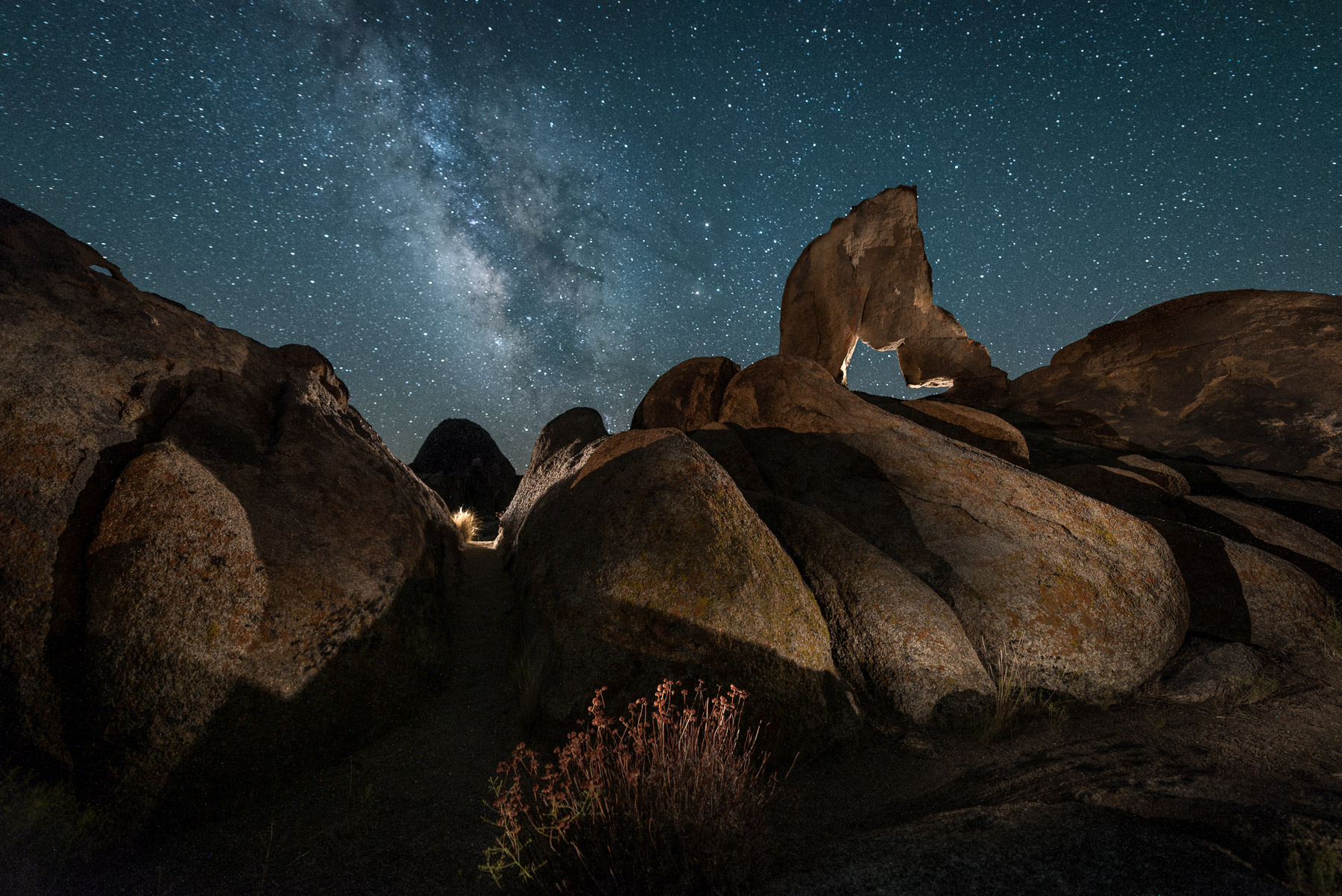
The Alabama Hills in California's Eastern Sierra are a great location for night photography and light painting.

The Alabama Hills in California's Eastern Sierra are a great location for night photography and light painting.

If you are not familiar with the Alabama Hills, it’s a unique geologic area in the foothills below Mt. Whitney, the tallest mountain in the continental United States. There are dozens of unique rock formations, most notably the famous Mobius Arch. It’s a fantastic place for night photography, and a place where I often teach workshops (including one this October). The eastern Sierra in general is somewhat of a Mecca for night photography, with many great attractions such as Mono Lake and nearby Yosemite National Park.

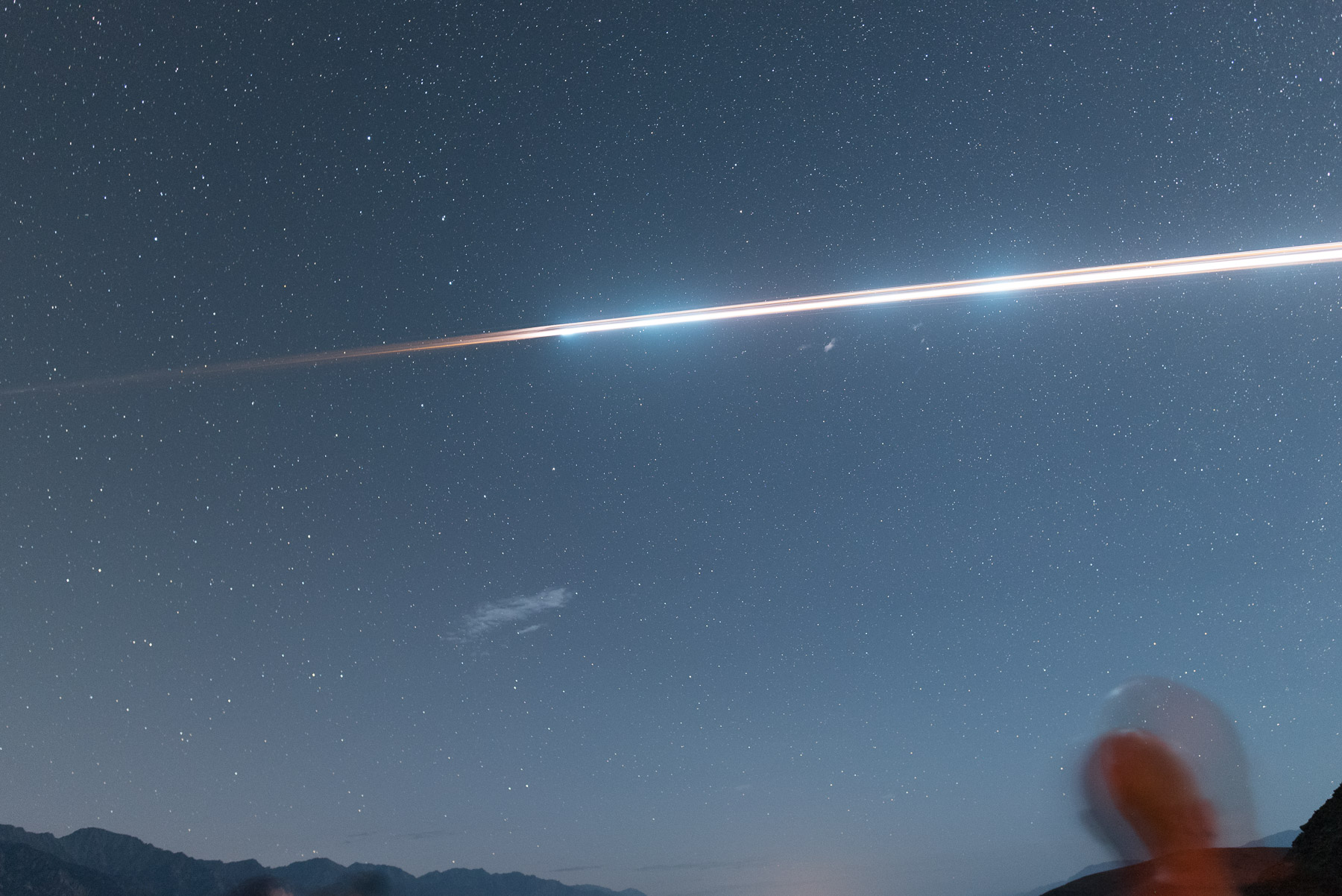
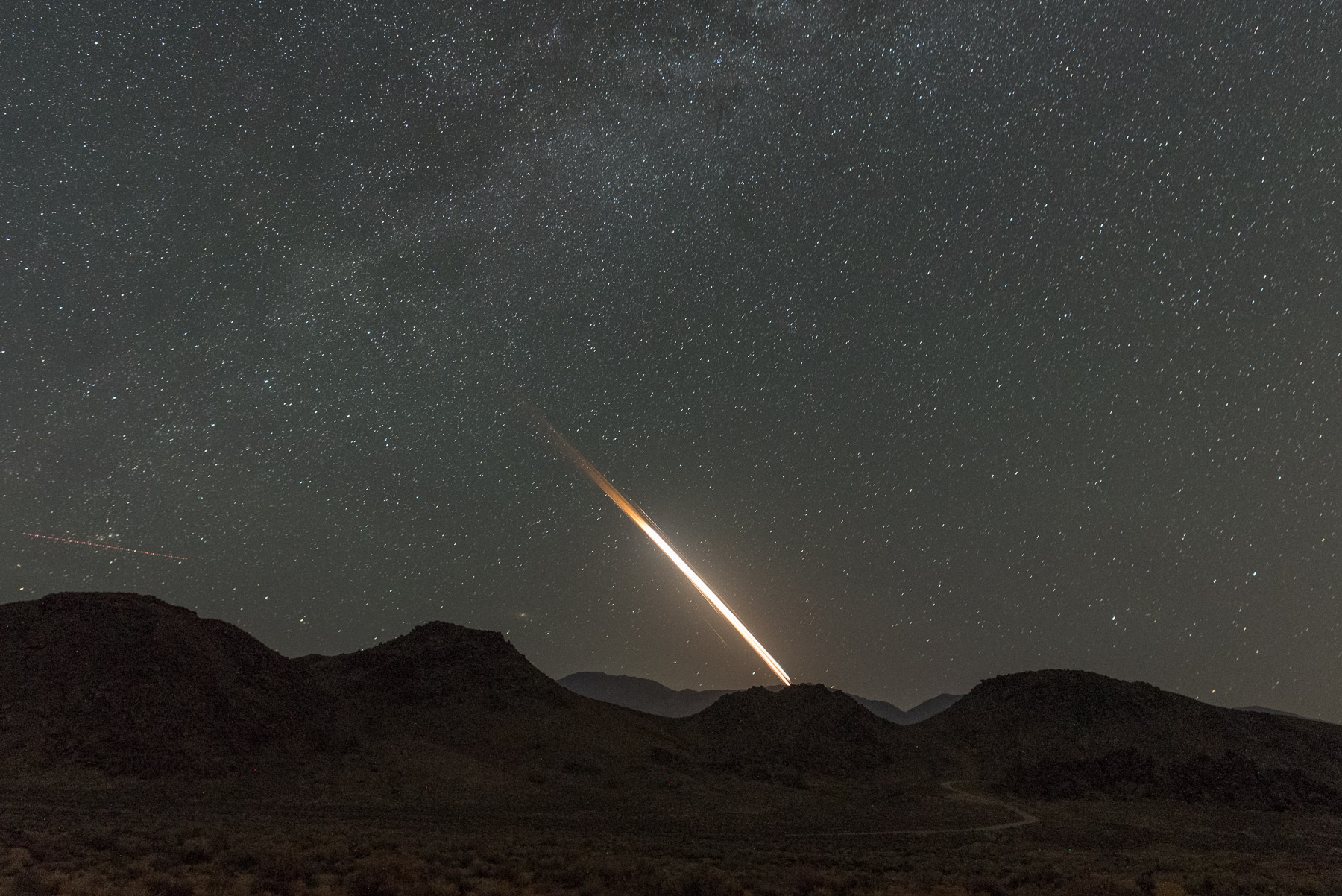
On Wednesday, July 27, the CreativeLive team and I were scouting the location to prepare for our shoot the next night, hoping to see a few meteors from the impending Delta Aquarids meteor shower. We were not disappointed, but the highlight of the night had nothing to do with the Delta Aquarids! At 9:38 p.m., we witnessed a tremendous fireball streaking across the sky. It turned out to be 8 tons of aluminum, the remnants of a Chinese CZ-7 rocket disintegrating as it re-entered the atmosphere!

As luck would have it, the CreativeLive crew was set up with their Sony a7S cameras and were able to record the fireball slowly traveling across the sky. We witnessed this awesome spectacle for over a minute. It was slow-moving (or appeared so to us), varied in intensity and color, and we could see multiple trails as pieces broke off as it descended further into the atmosphere. Check out the video:

In addition to the pyrotechnics, Ian Norman from LonelySpeck.com was on-site with us, talking about his infinity focusing aid, the SharpStar2. The SS2 is based on a device used by astronomers, called a Bahtinov Mask. SharpStar uses the properties of optical diffraction to create a set of three fine spike lines around a bright star. These diffraction spikes shift position as you focus your camera; adjusting focus so the central diffraction spike sits evenly between the other two diffraction spikes ensures perfect focus.

I have been following Ian’s work for the last couple of years, and have been mightily impressed by his work in the field of Astro-Landscape Photography. He has a huge following, and was about to lead a meetup two nights later at Trona Pinnacles where over 100 people would come together to photograph the night sky. Ian also had a Sony a7S trained on the sky, and produced his own video, which can be seen on his YouTube channel:

The CreativeLive course

While the fireball made news across the several states where it was seen that night, we took it as a sign that Night Photography Week was off to a roaring early start. Working with the crew from CreativeLive was fantastic—they were enthusiastic, fun and professional, and we spent two long nights filming the content for my upcoming segment of the course.

Here is an overview of what you can expect from the entire endeavor, to air on CreativeLive in September:

Basics of Night Photography

Gabriel Biderman will be teaching the fundamentals for all the night-photography beginners out there, exploring gear, how to catch the stars and the dynamic landscapes when photographing in national parks, and also when capturing in urban settings.

Shoot Preparation

Chris Nicholson, the author of Photographing National Parks, will help photographers prepare for their night shoots, from planning which parks to photograph, to fundamentals of safety, and how to scout locations for night photography shoots.

Astro-Landscapes

Again, I will cover how to capture truly out-of-this-world imagery, including how to capture the Milky Way and star trails.

Light Painting

Tim Cooper will introduce both the basics and the finer points of light painting, adding a dynamic element to your landscapes with light writing or accenting different elements of your compositions.

Portraits At Night

Lastly, Matt Hill will teach how to do night portraits. Using your friends or models, discover how you can capture amazing portraits in urban environments and national parks, without losing the amazing sky as a background.

The program airs September 12 to 16, and will be free during the initial broadcast. Afterward, lifetime access to the entire series can be purchased for $199. Join us to uncover and capture the night sky. RSVP now!

NPAN is thrilled to be working with CreativeLive on what we hope will be the first of many collaborative efforts together!

Lance Keimig has been photographing at night for 30 years, and is the author of Night Photography and Light Painting: Finding Your Way in the Dark (Focal Press, 2015). Learn more about his images and workshops at www.thenightskye.com.

UPCOMING WORKSHOPS FROM NATIONAL PARKS AT NIGHT

Talks & Walks: Visit us at two great NYC conferences this October!

In October, we have two events in NYC where you can come meet us in person, chat and see some lectures:

Out of New York 2016

When: Friday, October 14, 2016 - Sunday, October 16, 2016

We're very excited to be a part of this conference that has been operating in Chicago for a few very successful years, and is now offering a weekend of spectacular educational opportunities in New York City.

National Parks at Night will have a booth on the vendor floor, where you can come chat with us in-person about all the adventures we're planning for 2017 and beyond. It's also an opportunity to pick up any or all of the several books published by our team, on topics such as night photography, HDR and photographing the national parks.

Additionally, our instructors Gabriel Biderman and Chris Nicholson will be presenting talks ("Night Photography: From Snapshots to Great Shots" and "Photographing National Parks," respectively) and offering two night-photography walks in New York City.

More information: ny.outofchicago.com.


Photo Plus Expo 2016

When: Saturday October 22 from 10:15 a.m. to 12:15 p.m.

We are also very excited to be back at PhotoPlus, where we officially went public with the National Parks at Night program last year. (1st birthday! Yay!) Four of the five of us will be present and on stage for "Night Photography—Master the Night," a panel presentation about our favorite subject!

Gabe, Chris, Lance Keimig and I will share a ton of tips on shooting under the stars in beautiful places. We'd love to see you there, at one of the industry's premier events! 

Bring a friend—or two!

Register: www.photoplusexpo.com

More info / add to your expo planner: n2b.goexposoftware.com/events/ppe16/goExpo/user/listSeminars.php?ci=91

 
See more about Matt's photography, art, workshops and writing at MattHillArt.com. Follow Matt on Twitter Instagram Facebook.

UPCOMING WORKSHOPS FROM NATIONAL PARKS AT NIGHT

How to Get Creative in National Parks without Being an Asshat

Header photo credit: Night sky at Owachomo Bridge (NPS/Jacob W. Frank)
 

THE PROBLEM

I am horrified by mentions of how careless individuals mistreat natural features in national parks. I want to draw attention to this, plus provide some helpful tips on how we can all honor our muse while also avoiding destructive actions. 

And it's also a warning to the careless punks that if I ever see you defacing or endangering something beautiful, I will find a ranger and get your butt arrested and hopefully fined out the wazoo.

SOME EXAMPLES

Let's review some examples of misbehavior in national parks. 

Recently a young artist with the internet moniker Creepytings2014 chose to leave some graffiti behind in seven national parks while hiking. Her choice to post photos of it on her Instagram was hard evidence. Fortunately, some popular hiking sites started discussions about it, and formed a petition to the Obama administration asking for action. She was banned from 524 million acres of public lands during two years of probation, plus 200 hours of community service.

#NatureIsGay #creepytings #caseynocketart

A photo posted by Casey Nocket (@theofficialcreepytings) on

Another from this year: The Canadian group High on Life SundayFundayz got lambasted by the internet for their jaunt onto Grand Prismatic Spring in Yellowstone. They attempted amends, and many didn't believe it sufficed, calling for prosecution. Wyoming issued warrants for their arrest.

And this came not a year after some poor fellow crashed his drone into that same hot spring, despite the aerial devices being banned from all U.S. national parks just two months before. The Dutch tourist had to pay $3,200 in fines and restitution, amid continued fears that the sunken drone could still degrade or even destroy the colorful spring.

Those are new examples, but the problem is certainly not new. In 2001, a Utah photographer plead guilty to seven federal misdemeanors for damaging Canyonlands and Arches national parks. Simply put, he had built fires with Duraflame logs to create dramatic lighting effects, scorching and discoloring iconic rock formations. He paid $10,900 in restitution.

I provide these examples not to single out anyone, but examples are needed. I want to illustrate that if you choose to deface or damage national parks, you can (and should, IMO) pay a steep price. Not only that, but let's imagine what you are taking away from every other person and generation that visits that spot ever after. It's selfish, and short-sighted.

Here is a very simple list of destructive ways I've seen others apply their creativity that could cause negative impact within a national park:

  1. Using steel wool to make fire, especially during dry or forest-fire season (as happened in an incident in Big Cypress National Preserve just a couple of months ago, burning down a historic structure)

  2. Fireworks: sparklers, rockets, firecrackers, etc.

  3. Climbing on delicate features (they took millions of years to become that way, you can destroy it in a moment!)

HOW TO PREPARE AND ACT

Now that I've gotten the emotions out of the way, let's approach this with a little empathy. 

I believe it's first a matter of awareness. Not everyone thinks to read all the literature you get while on vacation or especially adventures. I mean, you're outdoors to have some time away from the hustle and bustle, right? Frankly, it doesn't mean you are off the hook of being responsible for your actions. By entering National Park lands, you are agreeing to leave it as you found it. Or perhaps you'll leave it in a better state and pick up someone else's litter.

Read the map and newsletter you are handed by the friendly rangers on the way in. You will get a great overview of all that is precious, plus the ground rules.

Let's take a look at the benchmark rule-book for how to treat the wilderness—the Center for Outdoor Ethics's simple “Leave No Trace Seven Principles.”

  1. Plan Ahead and Prepare

  2. Travel and Camp on Durable Surfaces

  3. Dispose of Waste Properly

  4. Leave What You Find

  5. Minimize Campfire Impacts

  6. Respect Wildlife

  7. Be Considerate of Other Visitors

© 1999 by the Leave No Trace Center for Outdoor Ethics: www.LNT.org

It's not so hard so minimize your impact on a natural environment. Print out their principles. Memorize them. Apply them. Get a tattoo. It's good karma. At National Parks at Night, we spend time on these ideals during every workshop. It's in everyone's best interest.

Delicate Arch at Night with Headlamp. NPS Photo.

HOW TO ACT 

If you are in a national park and are tempted to do something to leave your mark or do something you know is risky, ask yourself, "Who is this for? Me? Why am I doing it? What is the benefit of completing this idea?"

If you don't have an answer that rings true with your moral compass, give it a pass. Find another way to express yourself.

Another approach is to be deliberate. Make your own personal plan about what you want from your photo adventure.

We all have a mission, even if we've never written it down or spoken it aloud. I suggest before heading out into the wild, work on your artistic mission statement.

We were inspired by the mission statement (which you can read in its original form at the bottom of this page) of Thomas Mark Szelog, a photographer who is documenting the proposed new national park in the North Maine Woods. His statement describes exactly the sort of sentiment we should all have when we step anywhere into the great outdoors.

When I venture into the northern Maine forest I am fully aware that I am a guest in a house and home. And as any visitor into a home should, I behave properly. The denizens of the forest are no different than the human denizens of a city. The wildlife must seek food, water, and shelter. They use their home, the forest, to sleep, eat, rest, and reproduce and raise their families. I would not deny the right of a person to thrive in their home, nor would I deny the same for the wild creatures of the woods. ...

Mankind will never improve upon the beauty of Mother Nature. No manipulation of my photographs, or any use of computer or digital technology will make my images better. What nature allows me to see through my camera viewfinder is already outstanding. Mother Nature deserves all of the credit for the beauty in my photographs.

Wildlife photography is more than creating art, it is capturing an experience. — Thomas Mark Szelog

There is a power in writing down (and sharing!) a commitment. Try it. Write five sentences detailing who, what, where, when and how you will seek and apply your photographic vision.  Here is my first crack at it:

I, Matt Hill, choose to make art in the wilds of America's National Parks. I choose this because the natural beauty invokes awe and creative energy in me. I harness and focus this energy by applying the non-destructive media of light and time to make long-exposure photographs of night scenes. I adhere to the Leave No Trace Principles and share my photography so that it may inspire others to enjoy these spaces firsthand.

I challenge you to leave your personal version in the comments if you will. If you want to use mine and adjust it slightly, no worries! I would be honored.

Please choose to honor the natural beauty instead of modifying it. As Chris Nicholson has said to me in conversation, "The parks are our subject and inspiration, not our canvas." Well put, Chris.
See more about Matt's photography, art, workshops and writing at MattHillArt.com. Follow Matt on Twitter Instagram Facebook.

Upcoming workshops from National Parks at Night